While the combustible nature of biomass dust is well-established, pyrolysis can sometimes increase its explosive properties, something we should keep in mind when doing risk assessments and safety protocols.
During pyrolysis, the material’s volatile components are driven off, resulting in a product with a much higher carbon content and significantly reduced moisture. This leads to greater reactivity and an increase in the inherent risks of the dust.
1. Increased Ignition Sensitivity
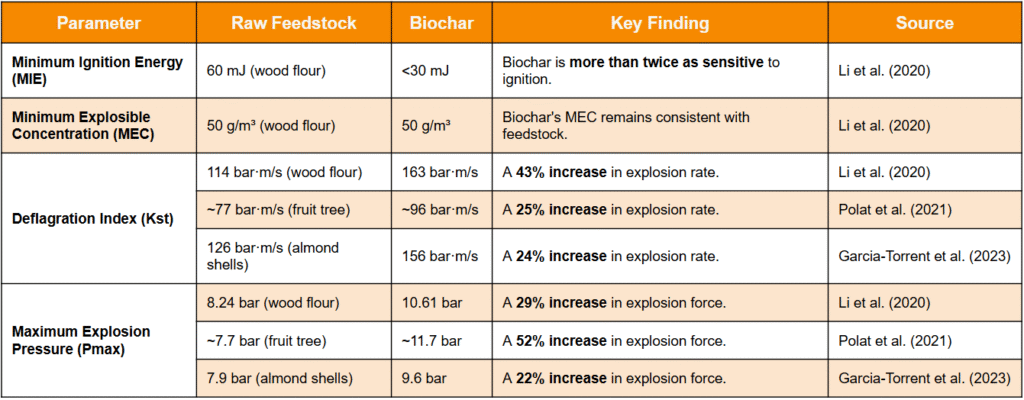
The Minimum Ignition Energy (MIE) of biochar is demonstrably lower than that of raw biomass. A study by Li et al. (2020) showed MIE values for wood flour biochar at 500°C of <30 mJ, compared to 60 mJ when it’s raw. This means a smaller ignition source, such as a low-energy static spark, could be sufficient to ignite a biochar dust cloud.
2. Increased Explosion Severity
Research consistently reveals an increase in the force and rate of a potential explosion. For example:
– Max. Explosion Pressure (Pmax): Studies show Pmax values for biochar increasing by as much as 1.5 times the original feedstock, reaching a peak of ~11.7 bar. (Garcia-Torrent et al., 2023; Polat et al., 2021)
– Deflagration Index (Kst): Kst values have been found to increase from a range of ~77 bar·m/s for raw biomass to a peak of 163 bar·m/s for biochar. (Li et al., 2020; Polat et al., 2021)
The Takeaway
While biochar presents a higher hazard level, this does not necessarily mean there is a higher probability of an event. For a risk to become an incident, all sides of the dust explosion pentagon must be present.
However, the change in hazard level means our risk management must be accurate. It is essential to have a Dust Hazard Analysis (DHA) that specifically accounts for the biochar. By taking this data-driven approach, you can accurately populate your risk registers and select the correct mitigating actions, ensuring the hazard is managed, not just feared.
Next time, we’ll explore the Hierarchy of Controls and how we can use this to reduce the likelihood of an event.
If you found this information valuable, please share it to help raise awareness of these risks in our industry.
Lyntra
Citations:
– Li, G., et al. (2020). Influence of pyrolysis temperature on the ignition and explosion characteristics of wood flour dust. Journal of Cleaner Production.
– Garcia-Torrent, J., et al. (2023). Explosibility and thermal risk characterization of dust from different biomass waste. Journal of Hazardous Materials.
– Polat, J., et al. (2021). Influence of the pyrolysis process applied to waste branches biomass from fruit trees on the calorific value of the biochar and dust explosivity. Energies.