Biomass

šŸ‚ Beyond the Number: How Seasons Shape Biomass Drying for Pyrolysis

We often rely on a single Moisture Content (MC) value when prepping biomass. This number, however, masks critical seasonal changes that dictate drying efficiency and final product yields. Optimising your process means understanding the quality of the water, not just the quantity. šŸ’§ Free vs. Bound Water: The Drying Energy Gap Water within biomass isn’t […]

šŸ‚ Beyond the Number: How Seasons Shape Biomass Drying for Pyrolysis Read More Ā»

Combustible Dust Safety Self-Assessment

Operating a biomass pyrolysis facility? Use this 25-point checklist to evaluate your current dust explosion prevention controls. This self-assessment covers the hierarchy of controls—from elimination and substitution through to engineering and administrative measures—helping you identify potential gaps in your safety program. This is a screening tool only. It provides an initial indication of your risk

Combustible Dust Safety Self-Assessment Read More Ā»

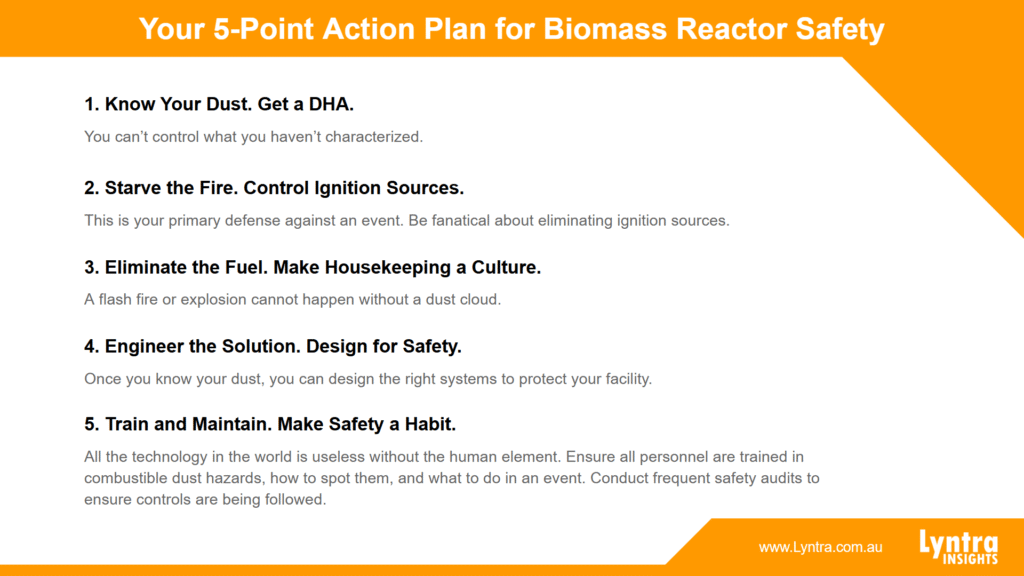
The Final Piece: Your 5-Point Action Plan for Biomass Reactor Safety šŸ’„

From the science of a dust explosion to the practical controls, we’ve covered a lot. As we close this discussion, here is a final guide for anyone operating a biomass pyrolysis reactor. Remember these key facts: – Biochar dust is a major hazard, often more explosive than its feedstock. – The Hierarchy of Controls is

The Final Piece: Your 5-Point Action Plan for Biomass Reactor Safety šŸ’„ Read More Ā»

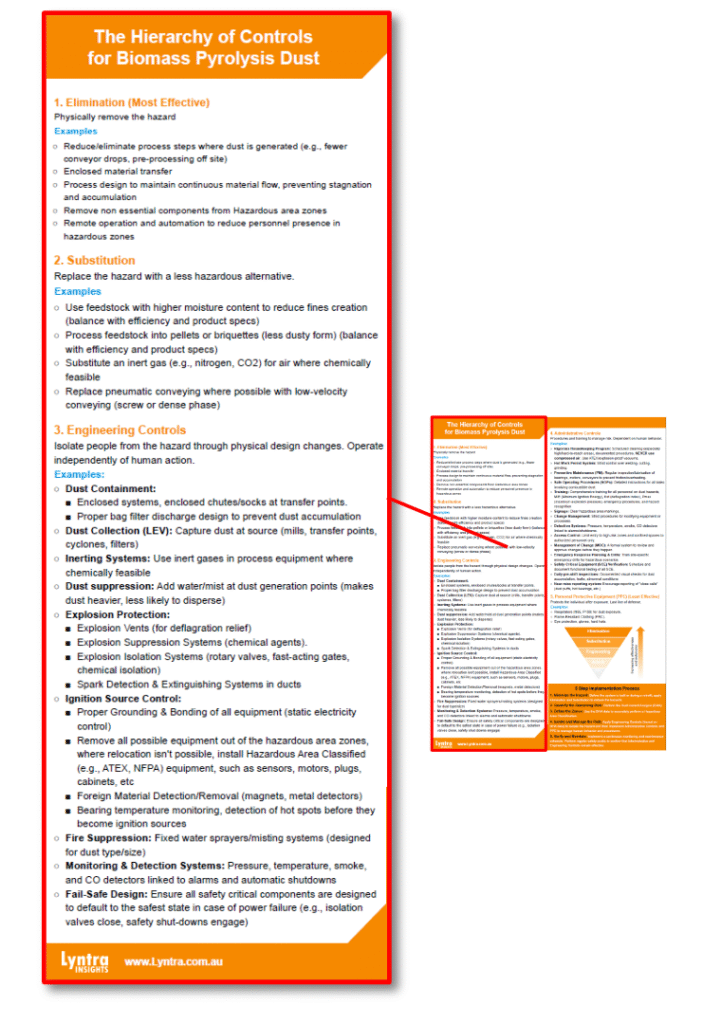
Your Safety Blueprint: The Hierarchy of Controls (Part 2 of 2)

In Part 1, we covered the robust, human-independent controls: Elimination, Substitution, and Engineering. Now, we move to the final two layers of the safety blueprint, the essential, human-driven protocols that keep those engineered systems effective. These layers rely on people and discipline. They are the necessary defense when physical barriers fail. 4. Administrative Controls (The

Your Safety Blueprint: The Hierarchy of Controls (Part 2 of 2) Read More Ā»

Your Safety Blueprint: The Hierarchy of Controls (Part 1 of 2)

In our last post, we established that biochar presents a greater hazard than its feedstock. Now, let’s explore the most effective framework for managing that risk: The Hierarchy of Controls. This is the universal blueprint for safety, prioritising the most reliable controls at the top. We’ll apply the most effective levels to biomass pyrolysis dust.

Your Safety Blueprint: The Hierarchy of Controls (Part 1 of 2) Read More Ā»

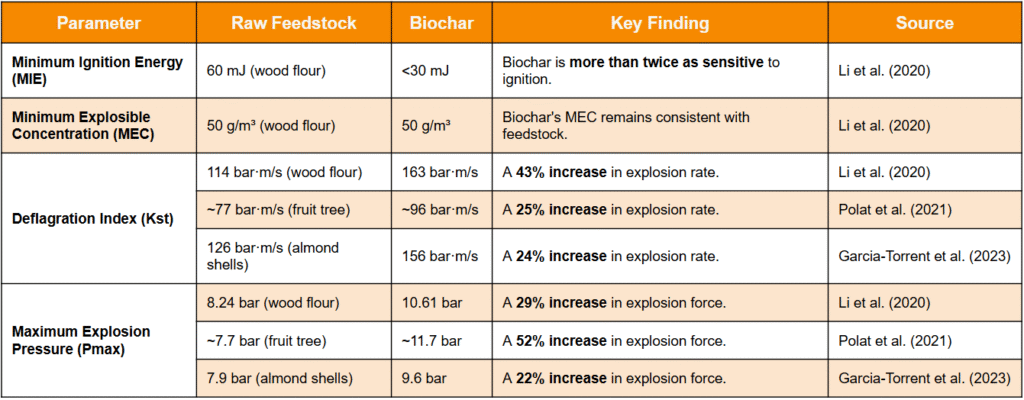
The Impact of Pyrolysis on Dust Explosibility: A Look at Biochar

While the combustible nature of biomass dust is well-established, pyrolysis can sometimes increase its explosive properties, something we should keep in mind when doing risk assessments and safety protocols. During pyrolysis, the material’s volatile components are driven off, resulting in a product with a much higher carbon content and significantly reduced moisture. This leads to

The Impact of Pyrolysis on Dust Explosibility: A Look at Biochar Read More Ā»

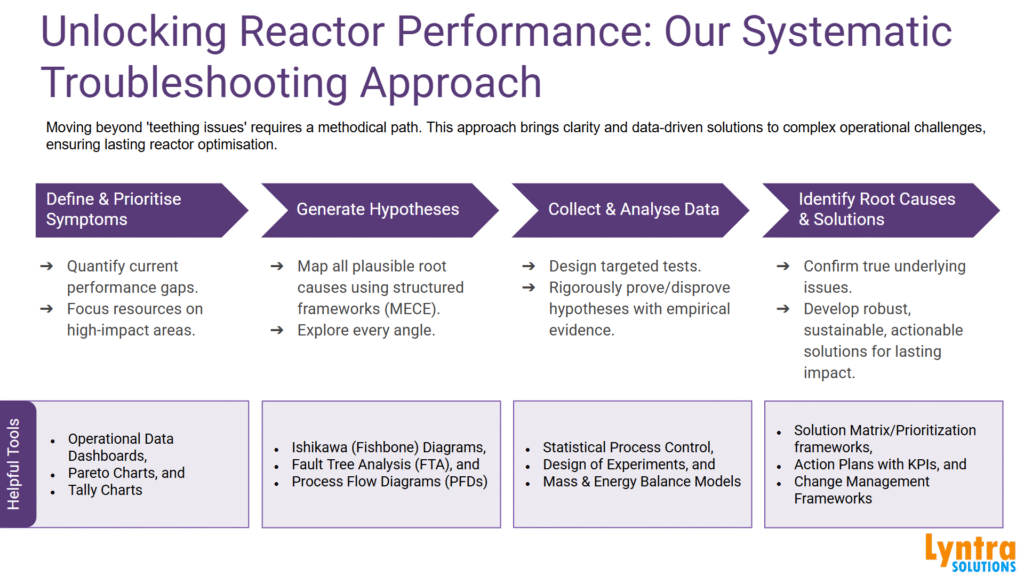
Unlocking Reactor Performance: Our systematic troubleshooting approach

When it comes to newly installed pyrolysis reactors, the journey from commissioning to optimal performance isn’t always a straight line. Sometimes, even with top-tier equipment, we encounter those elusive operational challenges that impact everything from yield to product quality. I’ve been reflecting on why some reactors don’t immediately hit their stride. It’s often not about

Unlocking Reactor Performance: Our systematic troubleshooting approach Read More Ā»

Beyond the Boom: Deflagration vs. Detonation – Why This Distinction is Critical in Biomass Pyrolysis šŸ”„šŸ’„

Following up on the excellent questions from our recent post, let’s dive into a crucial, and often misunderstood, aspect of explosions: the difference between a deflagration and a detonation. While both are dangerous, understanding this distinction is key to protecting our facilities. 1. The “Normal” Explosion: DeflagrationAs we discussed with the “dust explosion pentagon,” a

Beyond the Boom: Deflagration vs. Detonation – Why This Distinction is Critical in Biomass Pyrolysis šŸ”„šŸ’„ Read More Ā»

Beyond the Boom: Why Biomass Dust Fires and Flash Fires Are Still a Critical Threat šŸ”„

Following our discussion on dust explosions, let’s clarify another serious hazard: dust fires and flash fires. While they lack a destructive pressure wave, they are still incredibly dangerous and can precede a catastrophic event. 1. The Critical Distinction: Fire vs. Explosion Remember the “dust explosion pentagon”? – Dust Fire / Flash Fire: Occurs when fuel

Beyond the Boom: Why Biomass Dust Fires and Flash Fires Are Still a Critical Threat šŸ”„ Read More Ā»